



















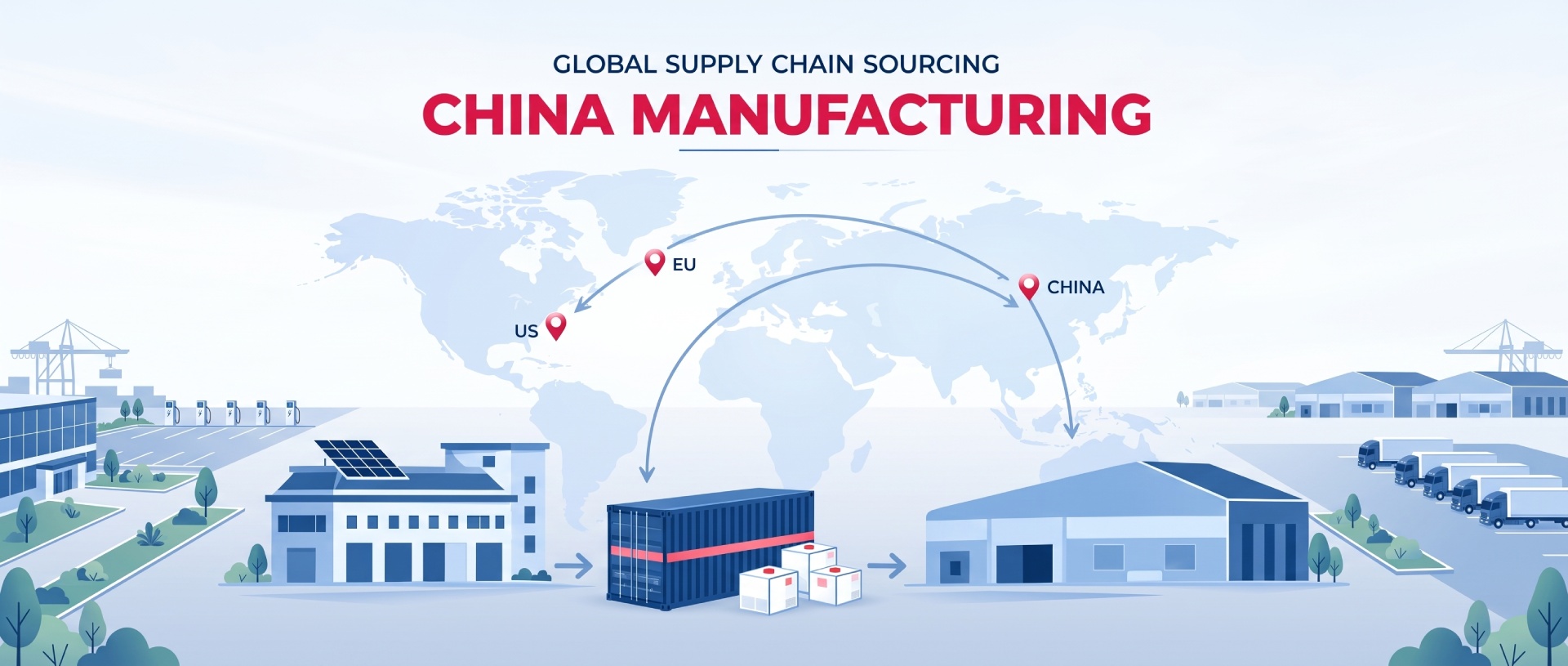
For decades, China has played an important role in the global manufacturing and sourcing ecosystem for sexual wellness products. But the reason international buyers source from China is changing.
Cost remains important. However, as brands face shorter product cycles, higher compliance expectations, increasing product complexity and greater pressure to differentiate, the competitive advantage of a supply chain can no longer be measured by unit price alone.
Looking toward 2027, global sexual wellness buyers may need to evaluate Chinese suppliers through a broader lens.
From Low Cost to Supply-Chain Capability
The traditional sourcing model focused heavily on one question: "What is your best price?". Price will always matter in B2B sourcing. But the lowest quotation does not necessarily produce the lowest total cost.
Product delays, unstable quality, communication errors, unsuccessful product development, compliance issues and inconsistent mass production can quickly eliminate the savings created by a lower unit price.
As the sexual wellness industry matures, sourcing decisions increasingly need to consider: Speed · Flexibility · Quality · Development Capability · Supply-Chain Integration · Compliance Awareness.
1. Manufacturing Clusters Remain an Important Advantage
One of China's major strengths is not simply the number of factories. It is the density of specialized supply chains. In manufacturing regions such as Dongguan and Shenzhen, product development can draw on interconnected resources involving:
- Industrial design
- Mold development
- Liquid silicone processing
- Plastic injection molding
- Motors
- Batteries
- PCBs and electronic components
- Charging systems
- Packaging
- Printing
- Quality inspection
- Logistics and export services
For sexual wellness products, which increasingly combine industrial design, soft materials, electronics and packaging, access to this ecosystem can shorten communication and development cycles. The advantage is therefore not just manufacturing capacity. It is integration.
2. Product Development Speed Is Becoming More Valuable
Sexual wellness trends move quickly. A product concept that looks differentiated today may face multiple similar products by the time it reaches the market. This makes development speed commercially important.
Global buyers increasingly need supply partners capable of moving efficiently from: Concept → Design → Engineering → Prototype → Testing → Tooling → Packaging → Production.
However, speed should not mean skipping validation. The stronger model is: faster development with controlled decision points.
3. Flexible Supply Chains Can Support Market Testing
Not every new product should begin with a large order. For emerging brands, new categories or uncertain markets, smaller initial quantities can provide valuable market feedback before larger investments are made.
Flexible sourcing can allow brands to test new product categories, new colors, packaging concepts, different price points and market-specific assortments. Successful products can then move toward larger-volume programs. For B2B buyers, flexibility can therefore become part of risk management.
4. International Uncertainty Is Changing Sourcing Decisions
Global sourcing in 2026-2027 continues to operate in an environment shaped by trade-policy uncertainty, tariff exposure, logistics changes, regulatory developments and geopolitical risk. This encourages greater attention to supply-chain resilience.
Some companies are diversifying manufacturing or adopting "China + 1" strategies. But diversification does not necessarily eliminate the role of China. Instead, it may change that role.
China can remain particularly competitive where products require integrated electronics, tooling, silicone processing, rapid development and access to a broad component ecosystem. The sourcing question is therefore becoming more sophisticated than simply choosing one country over another.
5. Compliance Costs Are Becoming Part of Product Economics
International regulations increasingly affect product development, documentation, packaging, batteries, electronics, traceability and connected devices. For global buyers, this means compliance should be considered as part of total product cost.
Suppliers serving international markets therefore need stronger awareness of destination-market requirements. The future advantage will not simply be "We can manufacture this." It will increasingly be "We understand what needs to be considered before manufacturing this for your market."
6. Quality Control Is Moving Beyond Final Inspection
Traditional sourcing often treats quality control as a final inspection performed before shipment. For more complex products, this is not enough.
Material selection, motor specifications, battery configuration, PCB design, waterproof structure, silicone thickness and assembly tolerances can all affect final performance. Effective quality management therefore needs multiple control points: Specification Confirmation → Component Control → Production Control → Functional Testing → Pre-Shipment Inspection.
Quality should be built into the product — not inspected into it at the end.
7. Original Development Can Create More Value Than Catalog Sourcing
Catalog products remain important for wholesalers, retailers and brands that need fast market entry. But as product similarity increases, original development becomes increasingly valuable.
Custom ergonomics, differentiated forms, exclusive colors, improved structures, new functions and coherent product families can help brands build stronger market identity. The strongest partnerships may increasingly involve suppliers who can contribute to development decisions rather than simply execute purchase orders.
What Should Global Buyers Look for in a Chinese Supply Partner?
Price and production capacity remain important, but they should be evaluated alongside several additional capabilities.
- Can the supplier understand your target market?
- Can they participate in product development?
- Can they coordinate multiple manufacturing processes?
- Can they identify engineering risks before tooling?
- Can they maintain quality consistency?
- Can they support customization without creating unnecessary complexity?
- Can they communicate clearly when problems occur?
- And perhaps most importantly: can they help you build a product that has a reason to compete in your market?
The Next Stage of China Sourcing
China's sexual wellness supply chain is unlikely to compete in the future through low cost alone. Its stronger long-term advantages may come from combining manufacturing infrastructure with faster development, engineering resources, supply-chain integration and increasingly sophisticated product capabilities.
For global brands and distributors, this creates an opportunity to rethink the traditional buyer-supplier relationship. Instead of treating sourcing as a transaction, the relationship can become: Market Need → Product Concept → Development → Validation → Production → Continuous Improvement.
At FUNVEN, this is how we see the future of B2B sexual wellness sourcing. Our role is not simply to connect buyers with products. We aim to combine Product Development, Supply-Chain Integration, Flexible Customization, Quality Control, Market Awareness and Reliable B2B Service to help our partners develop products that are commercially relevant and ready for international markets.